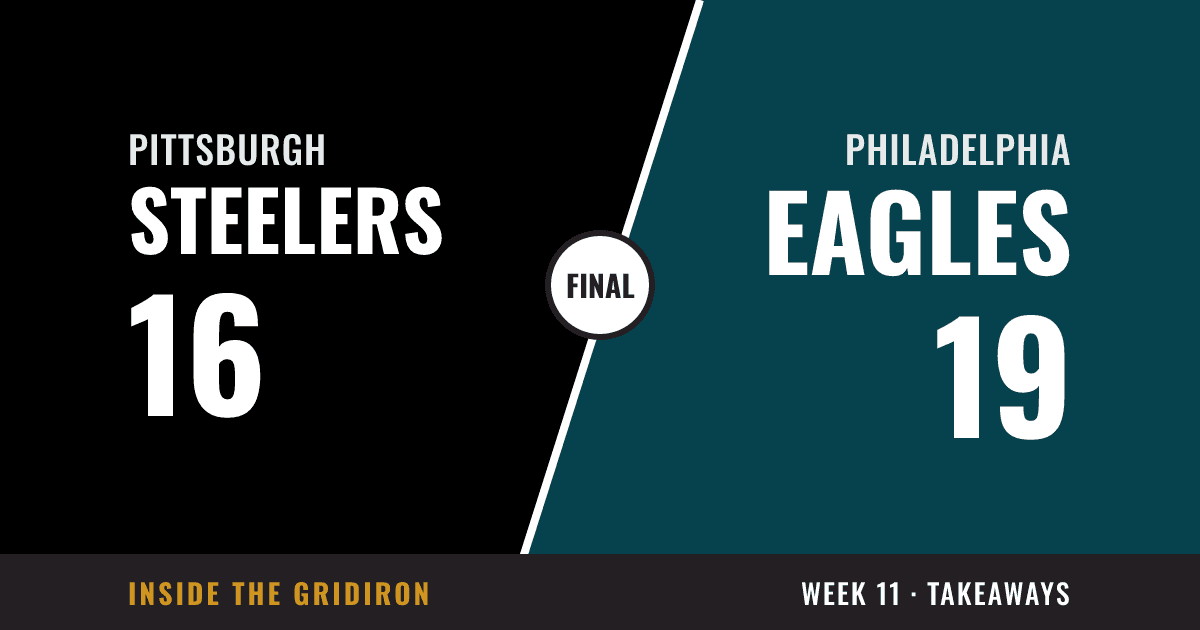
The Philadelphia Eagles beat the Pittsburgh Steelers 19-16 at Lincoln Financial Field on Sunday, holding on after Aaron Rodgers hit Max Hurleman for a 20-yard touchdown with 1:21 left. Philadelphia moves to 3-7, and Pittsburgh drops to 6-4.
Pittsburgh Won the Volume Battle and Lost the Scoreboard
The Steelers held the ball for 35:30 and ran 69 plays to Philadelphia's 50. They outgained the Eagles and piled up more first downs. None of that turned into enough points.
The extra snaps came cheap. Pittsburgh averaged 3.7 yards per play while Philadelphia averaged 4.3, so the Eagles did more with each snap even while running far fewer of them.
Third down and the red zone finished the job. The Steelers converted just 5 of 17 third downs and failed to score a touchdown on either red-zone trip. In a one-score game, coming up short of the end zone on those trips was the difference.
Total yards: PIT 255, PHI 214
Plays: PIT 69, PHI 50
Third down: PIT 5-17, PHI 4-13
Red zone: PIT 0-2, PHI 0-1
Possession: PIT 35:30, PHI 24:30
Jake Elliott Carried an Offense That Barely Moved
Philadelphia's offense managed 11 first downs and failed on its only red-zone trip. It won anyway because Jake Elliott kept turning modest possessions into points from long range.
Elliott hit from 41 and 29 yards in the first quarter, then from 53 and 55 after halftime. The 53-yarder answered a Chris Boswell field goal in the third quarter. The 55-yarder, with 4:19 left in the fourth, left Pittsburgh needing two scores.
That is why the Rodgers-to-Hurleman touchdown at 1:21 only pulled the Steelers back within a field goal. Without Elliott's range, Philadelphia does not win this game.
The Eagles' lone touchdown was Saquon Barkley's 38-yard run late in the first quarter. That score built the cushion Pittsburgh chased for the rest of the afternoon, and the Steelers never led.
Field goals: Jake Elliott – 41, 29, 53, 55 YDS; Chris Boswell – 25, 40, 52 YDS
Rushing TD: Saquon Barkley – 38 YDS
Passing TD: Aaron Rodgers to Max Hurleman – 20 YDS
The Eagles' Pass Rush Beat Pittsburgh's Passing Volume
Pittsburgh completed 30 of 44 passes, yet those throws produced just 182 net yards. Philadelphia sacked the Steelers 5 times for 45 yards, dragging the average down to 3.7 yards per pass.
The Eagles threw far less, completing 11 of 21, but averaged 5.1 yards per pass and allowed 3 sacks. Fewer throws, more per throw: that trade favored Philadelphia all afternoon.
The ground game offered Pittsburgh no relief either. The Steelers ran for 73 yards at 3.7 a carry, while the Eagles ran more often and finished ahead on the ground with 91 yards.
Pittsburgh also won the turnover battle, giving the ball away zero times while Philadelphia lost a fumble. Winning that column and the clock, then losing anyway, points straight at the sacks and the red-zone trips that ended without a touchdown.
Passing: PIT 30-44, 182 net YDS; PHI 11-21, 123 net YDS
Sacks allowed: PIT 5-45; PHI 3-18
Rushing: PIT 20 ATT, 73 YDS; PHI 26 ATT, 91 YDS
Turnovers: PIT 0, PHI 1
What It Means
Pittsburgh sits at 6-4, but the split tells the real story: 4-0 at home and 2-4 on the road. Until the road record catches up to the home one, the Steelers look like a contender only half the time.
This loss is the road problem in miniature. They controlled the ball away from home and still could not finish drives, and that is the issue to fix before the standings tighten.
Philadelphia is 3-7 and 2-4 at home. This win came from a kicker and a pass rush, not from an offense that gained 214 total yards. It counts the same in the standings, but it is not a formula the Eagles can lean on every week.